
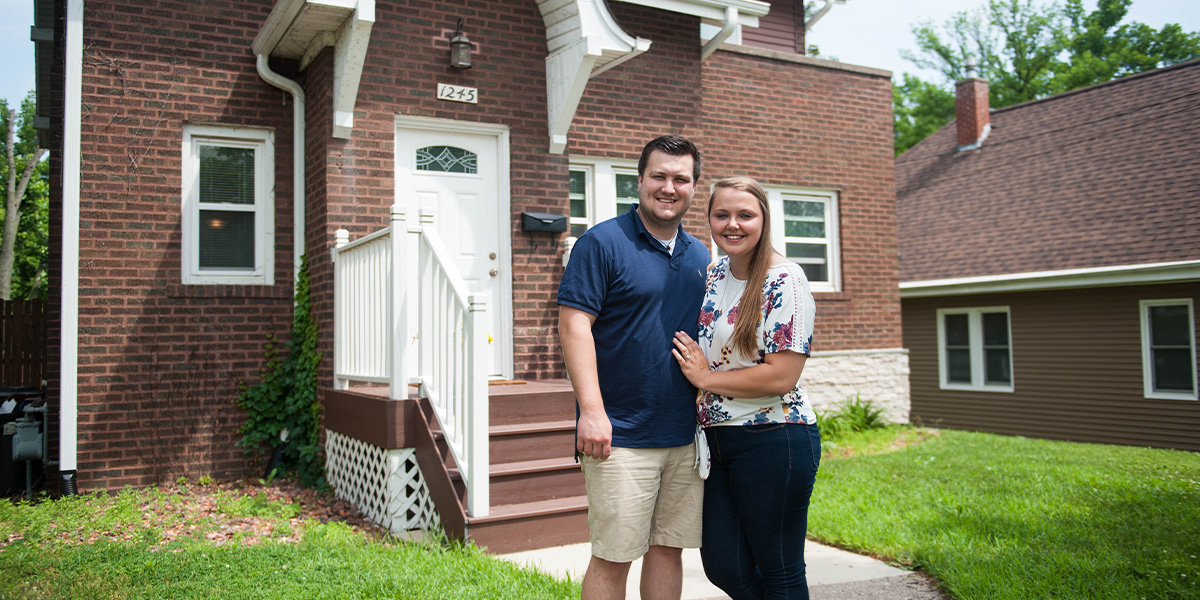
 Dupaco members Tom and Rebecca Ameche used the 80/15 loan option to purchase their first home. The newlyweds took out two mortgages to avoid paying Private Mortgage Insurance. The first mortgage was for 80% of the home’s value, the second for 15%. By piggybacking the loans—an option for qualified borrowers—the couple saves $160 in monthly PMI payments. (M. Blondin/Dupaco photo)
Don’t want to pay PMI? You might have options to avoid it
Updated Sept. 22, 2025, at 12:10 p.m. CT
By Krystal Frederick | Assistant vice president, mortgage lending
If you’re saving to buy a home but dreading the extra cost of private mortgage insurance (PMI), you’re not alone. Many first-time buyers have asked me the same question: Can I buy a home without 20% down and still avoid PMI?
The good news is there are a few smart ways to avoid it.
One popular option we use with members is our Split & Save loan, also known as an 80/15 loan or piggyback mortgage.
I’ll walk you through what PMI is, why it matters and the most practical ways you might be able to avoid it—so you can buy a home sooner.

What is PMI and why do lenders require it?
PMI (private mortgage insurance) is extra protection for your lender in case you’re unable to repay your loan.
The cost varies, but the payments can be costly. They can potentially add hundreds of dollars to your monthly payments—sometimes making homeownership unattainable.
How can you avoid paying PMI?
There are a few ways to buy a home without PMI:
- 80/15 loan (piggyback mortgage): Take out two loans instead of one. At Dupaco, it’s called a Split & Save loan.
- VA loans: Eligible veterans or service members can buy with no PMI and no down payment.
- Save or combine funds: Waiting until you have 20% down—or using gift funds from family—can also get you there.
Discover first-time homebuyer programs, grants and loans >
What’s an 80/15 loan (and how does it work)?
With a Split & Save loan, you’re essentially taking out what’s known in the mortgage world as an 80/15 loan. It’s been a great tool for many of our members. It works by splitting your financing into two loans at once:
- First mortgage: 80% of the home’s value
- Second mortgage: 15% of the home’s value
- Down payment: 5%
By structuring it this way, you keep your first mortgage at 80%, which means no PMI required.
A second mortgage carries certain requirements, though. These include:
- You’ll need at least a 5% down payment.
- The second loan is a 20-year term.
- It’s also a 5/1 adjustable-rate mortgage (ARM), meaning the interest rate is fixed for the first five years and can adjust annually after that.
- The loan must be at least $5,000.
Is a piggyback loan right for you?
This option isn’t for everyone. But it can be really helpful in certain situations.
Why members like it:
- They avoid PMI and start paying off the principal of their loan balance faster.
- It can help when one borrower’s credit score isn’t ideal.
- It’s a way to get into a home sooner when you don’t have 20% down.
What to consider carefully:
- After the first five years, the second loan’s interest rate can adjust every year, based on the Secured Overnight Financing Rate. Rates can’t rise more than 2% in one year or more than 6% over the life of the loan. But some borrowers don’t like the risk of an increased payment.
- Having a second mortgage means you can’t open a Home Equity Line of Credit until that second loan is paid off.
It’s worth running the numbers with us to make sure it fits comfortably into your budget.
What if you can’t avoid PMI?
Sometimes, paying PMI is the only path to homeownership. But that doesn’t mean you’ll always carry PMI.
You have a couple ways to eventually get rid of it:
- Once you’ve built at least 20% equity, you can contact Dupaco and request an appraisal (at your expense) to determine your home’s value.
- Once your loan balance drops to 78% of your home’s value, you can call Dupaco and request to have it removed—no appraisal required.
So, is it better to hold off on buying that house until you can afford a 20% down payment? Not necessarily.
If you can get into a home by paying only 5% down—and can make the payments work with your budget—you can start building equity, which is something you can’t do when you rent.
Why your credit score matters
Whether you’re looking at an 80/15 loan, a conventional mortgage or even dealing with PMI, your credit score plays a huge role.
It impacts:
- Your interest rate
- Your closing costs
- The amount you’ll pay if PMI is required (the higher your credit score, the lower your PMI payments will be)
That’s why I always recommend buyers start by checking and building their credit first.
Review your credit with a free Credit History Lesson >
Final thought
Avoiding PMI can save you money. But the right choice depends on your budget, timeline and credit.
Whether an 80/15 loan makes sense—or whether PMI is simply a short-term step toward homeownership—it’s important to know your options before you jump in.
I’ve seen members succeed with both paths. The key is making an informed decision that works for you.